WellbeingSolutions
Psychosocial risk assessment
Understand the conditions affecting your people. Use their feedback to guide practical workplace improvements.
WellbeingSolutions can support you to identify and manage psychosocial risks, part of your duty under the Health and Safety at Work Act 2015.
Australian WHS laws now spell out psychosocial hazards, and employers are expected to identify and manage them. Psychosocial hazards in Australia: state guide.
WellbeingSolutions can support you with that.
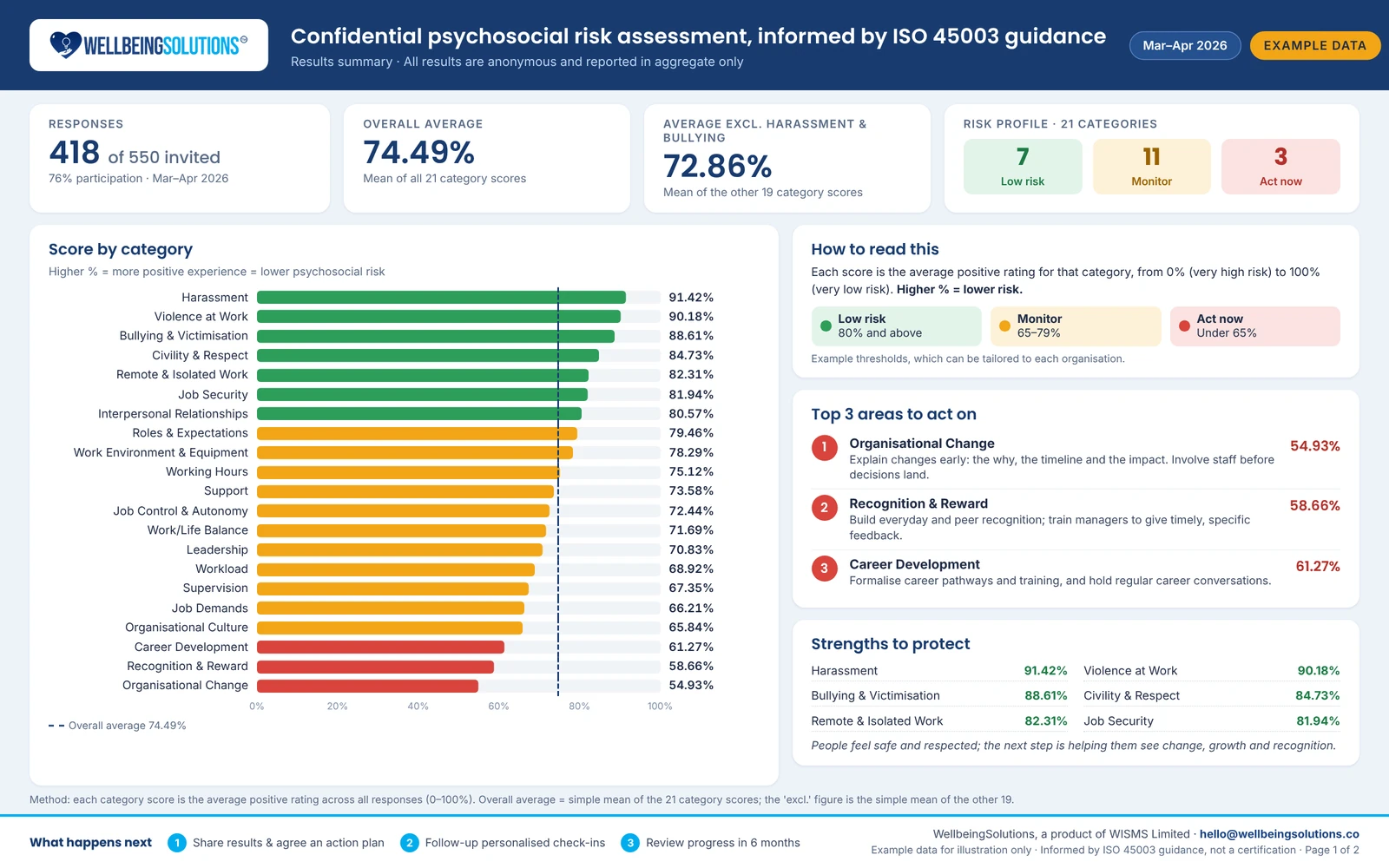
The assessment takes 8–12 minutes. It is sent by text, email or QR code, and no personal information is asked.

Guidance to support your process
ISO 45003 provides guidance for managing psychosocial risks at work. Our assessment approach is informed by that guidance. ISO 45003 is voluntary guidance; this assessment is not a certificate, a diagnostic assessment or a promise that an organisation meets its legal duties.
Read ISO’s description of ISO 45003.
Psychosocial hazards in New Zealand, Victoria and New South Wales
The same assessment supports organisations in New Zealand, Victoria and New South Wales. It is informed by ISO 45003 guidance. ISO 45003 is voluntary guidance; this assessment is not a certificate, and it is not a promise that an organisation meets its legal duties.
New Zealand
WorkSafe New Zealand describes how businesses can manage psychosocial risks at work. Anonymous workforce feedback can help an organisation see patterns and record hazards and controls in its own psychosocial risk register.
WorkSafe New Zealand: managing psychosocial risks at work.
Victoria
WorkSafe Victoria’s Occupational Health and Safety (Psychological Health) Regulations commenced on 1 December 2025. They set out how Victorian employers identify psychosocial hazards and control the risks. This assessment can gather anonymous feedback from workers. It is not a WorkSafe tool, and using it is not a claim that a duty has been met.
WorkSafe Victoria: psychological health regulations.
WorkSafe Victoria: tools to support psychosocial risk management.
New South Wales
SafeWork NSW publishes a code of practice for managing psychosocial hazards at work. Psychosocial provisions in the NSW WHS Regulation have applied from 1 Oct 2022, and now sit in the WHS Regulation 2025 Div 11, where r 55C applies the hierarchy of controls. From 1 Jul 2026, s 26A means businesses are expected to follow approved codes of practice, or manage the risk to an equal or higher standard. Parliament passed the Work Health and Safety Amendment (Digital Work Systems) Act 2026 in February 2026. This page does not claim that the assessment satisfies NSW law. Check SafeWork NSW for what is currently in force. The state-by-state guide sets out each Australian state and territory.
SafeWork NSW: code of practice for managing psychosocial hazards at work.
From assessment to action
- Agree the scope, participating groups and privacy arrangements.
- Gather workforce feedback and consult people about work pressures and support.
- Review aggregated findings in leadership reporting, including workload, relationships and working conditions.
- Prioritise practical controls, assign owners and review progress with workers.

Useful across different settings
For schools, explore teacher and staff working conditions alongside appropriate student support pathways. For corporate teams, consider job design, workload and organisational change. For high-risk workplaces, consider isolation, shifts, time away from home and access to support.
Protect individual participation
Explain what is collected, who receives it, how long it is kept and how participants can raise privacy concerns before collection. Agree minimum reporting groups and suppress identifying details. Individual clinical notes should not form part of employer dashboards.
Participation should be voluntary. Assessment responses should not be used for recruitment, disciplinary, performance or site-access decisions.
Scope and pricing
See our Pricing page for check-in pricing. Confidential Psychosocial Risk Assessment add-on (per year, excl GST): $2,995 up to 100 staff, including Small Teams. $4,495 for 101–249 staff. $6,995 for 250–499 staff. 500+ staff by quote, minimum $6,995. On a 3-year agreement, year 1 is 50% off until 11:59pm NZDT, Tuesday 15 December 2026, including Small Team. Years 2 and 3 are the full tier price, plus CPI. A 1-year agreement pays the full tier price, with no 50% off. Not part of the free pilot. We do not promise reduced insurance costs, absence or legal liability.
Discuss your assessment